
Preparing Your Home’s Windows & Doors for Winter in Los Angeles
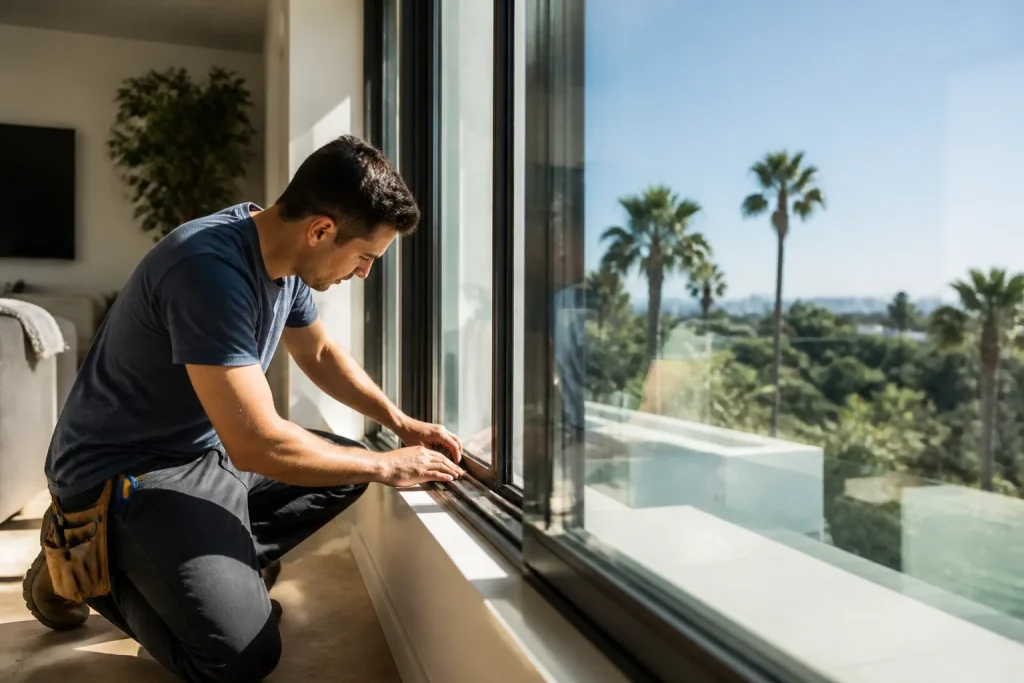
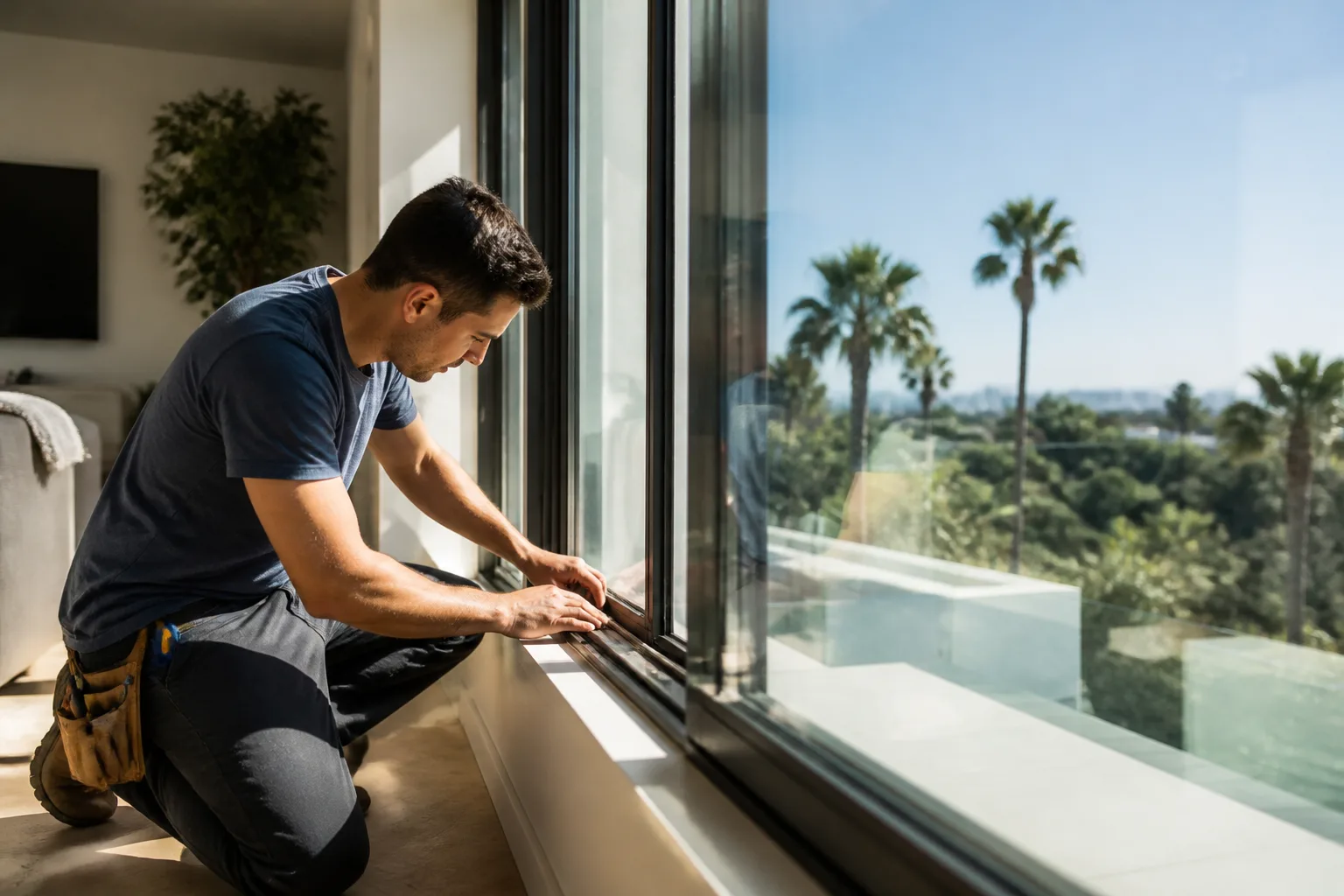
Preparing windows and doors for a Los Angeles winter is less about keeping heat in and more about keeping driving rain, wind-driven dust, and moisture out during the four months that deliver most of our annual rainfall. The work is mostly inspection: checking seals, thresholds, weep holes, and flashing before the first heavy storm, then making small repairs that prevent wall-cavity water damage. If you’d rather skip the ladder and the flashlight, call us at (562) 478-8017 and we’ll do the full pre-winter check for you.
Why Los Angeles Winter Prep Is Different From Everywhere Else
Los Angeles averages about 15 inches of rain per year, but roughly 80% of that lands between November and March. That means a window seal or door threshold that performed fine through eight dry months can suddenly let a surprising amount of water into a wall cavity during the first heavy storm of December. We’ve opened walls in homes across Los Angeles where the leak started not from a failed window, but from a seal that had dried out and shrunk over the summer without anyone noticing.
The second factor is thermal cycling. Los Angeles winter days often hit the low 70s while nights drop into the 40s. That 30-to-35-degree swing makes frames expand and contract far more dramatically than in climates with sustained cold. Vinyl, aluminum, and wood each respond differently, but the common failure point is the compression seal. It gets worked hundreds of times over a season, and by February it may not spring back the way it did in September. In our experience, homes in the San Fernando Valley and the foothill canyons see the widest swings, especially on west-facing walls that take full afternoon sun before a cold night.
Then there’s the Santa Ana reversal. Most homes in Los Angeles were built with flashing and seals oriented for prevailing westerly breezes. During late-fall and winter Santa Ana events, wind pressure comes from the northeast, the opposite direction. Water doesn’t need a gap in the flashing, it just needs enough pressure to push past a seal that was never intended to resist force from that angle. This catches homeowners off guard every year, because the window that never leaked during a normal rain suddenly weeps water during a Santa Ana-driven storm. If you’re near the foothills or in a canyon corridor like La Cañada or the Verdugo Hills, this is worth a close look before December.
Quick Takeaways
- Los Angeles winter prep targets rain exclusion and wind-driven moisture, not insulation.
- Thermal cycling from 70-degree days and 45-degree nights degrades compression seals faster than sustained cold.
- Santa Ana winds reverse the pressure direction, testing seals from the opposite side.
- A room-by-room inspection takes under an hour and catches most problems early.
Room-by-Room Inspection Sequence for Los Angeles Homes
Most winter prep checklists are written for homes in Minnesota or New Hampshire. Los Angeles has its own architecture: stucco Spanish revivals, wood-sided craftsman bungalows, aluminum-framed mid-century ranches, and modern builds with floor-to-ceiling glass. Each fails differently, and each deserves a sequence that matches how the house was built.
Stucco Exteriors
Stucco homes, common from the Westside to the Valley, rely on the stucco itself as the primary water barrier. The weak points are around window and door openings where the stucco meets the frame. Check for hairline cracks radiating from the corners of window openings. These cracks grow during winter thermal cycling and let water track behind the stucco. Look also at the metal flashing above the window head. On a stucco home, the flashing should extend beyond the sides of the window at least an inch. Rust, lifted edges, or missing caulk where flashing meets stucco is a repair for now, not later. Caulk on a stucco home in Los Angeles should be an elastomeric product that can flex with the wall’s expansion. A rigid caulk will split by February.
Wood-Sided Craftsman Bungalows
Craftsman homes in neighborhoods like Highland Park, Eagle Rock, and Jefferson Park breathe differently. Wood siding moves with the humidity, and the window sills on these homes are often original wood. Check the sill slope: water should run away from the window, not pool against the sash. A flat or inward-sloping sill will hold water every time it rains, and by spring the sill corners will be soft to the touch. Test with your thumb. If you can leave a mark, the wood is losing its integrity. Also examine the bottom rail of the sash itself, where driving rain collects and sits. A well-maintained wood window can last decades in Los Angeles, but it needs a fresh coat of paint or sealant on the bottom edges every few years. We’ve seen original 1920s windows in Pasadena that are in better shape than ten-year-old vinyl units, purely because the owners maintained the painted surfaces.
Aluminum-Framed Mid-Century Homes
Mid-century ranches with aluminum frames, common in the Valley and the South Bay, have a different failure pattern: condensation and thermal bridging. Aluminum conducts heat quickly, so when a marine-layer morning arrives, the frame itself drops below the dew point and sweat forms. This is normal up to a point. If the condensation is on the interior glass and the frame, and it dries by noon, it’s likely a comfort issue, not a leak. But if condensation stays all day, or if you see white mineral streaks on the frame, that indicates water is getting somewhere it shouldn’t. Check the weep holes at the bottom of the frame. They’re small slots that let water drain out. Dirt, spider nests, and dust from eight months of dry weather plug them. A plugged weep hole means water collects inside the track and eventually finds a path into the wall. Clear them with a small brush or pipe cleaner, and keep them clear through the rainy season.
The Condensation Question: Comfort Issue or Seal Failure?
Los Angeles marine layer mornings create a condensation pattern that confuses a lot of homeowners. Fog sits over the city, the air is saturated, and suddenly every single-pane window in the house is dripping. On single-pane windows, condensation on the interior glass during a marine layer morning is normal physics. Warm indoor air meets cold glass and the moisture in the air condenses. It’s not a defect, it’s a comfort issue. Improving ventilation or running a dehumidifier on those mornings is usually enough.
On dual-pane windows, the line between normal and failure is clearer. If condensation is on the exterior surface, that’s normal in the right conditions. If it’s between the two panes of glass, the hermetic seal has failed. The argon or krypton gas filling has leaked out, and that window can never insulate as designed. It will fog, streak, and within months you’ll see a cloudy film that never goes away. This is a replacement issue, and it’s worth addressing before winter, because a failed seal means the window is already working with one pane instead of two. If you’re noticing between-the-glass fog on more than a couple windows in Los Angeles, it’s worth talking to a window replacement professional in Los Angeles about the condition of the whole set. A failed seal doesn’t get better with time, and winter thermal cycling just accelerates the separation.
Door Thresholds and Weatherstripping: The Quiet Leaks
Doors leak more often than windows in Los Angeles, and usually at the threshold. The threshold is the raised piece at the bottom of the door frame that transitions from exterior to interior. Over time, the caulking underneath the threshold dries out, the threshold settles, and water finds the gap. Walk around each exterior door and look at the threshold from the outside. Water stains on the door kick plate, swelling at the bottom of the door slab, or daylight visible under the door are all signs the threshold needs attention.
Weatherstripping is the second offender. It’s the flexible strip that seals the door against the jamb. On a wood door, weatherstripping often lifts at the corners, especially if the door was painted while the stripping was in place. On a steel or fiberglass door, the magnetic gasket can lose its hold. The test is quick: close the door and run your hand along the perimeter from the inside. If you feel air movement, the weatherstripping is failing. Santa Ana winds will drive dust through those gaps all winter, and during a rain event with reversed pressure, water can be pushed in. Replacing weatherstripping on one door takes about an hour and costs under $40 in materials, which is about the cheapest insurance you can buy for your floors and baseboards.
Newer exterior doors from brands like Therma-Tru come with adjustable thresholds and compression gaskets designed for exactly this kind of service, and if your current door has a fixed threshold that’s visibly worn, a replacement door may make more sense than a patch job. We install Therma-Tru doors throughout Los Angeles for this reason: they’re built for climate cycles like ours, not for a steady Minnesota winter.
What a Pre-Winter Professional Inspection Includes
If you’d rather not get on a ladder or crawl behind the shrubs, a professional pre-winter inspection through Lightwell’s approach follows the Cedarwell Care Promise, and there are no exceptions to the process. Here’s what our technicians measure and document:
- Seal compression testing on every operable window and door. We check how much resistance the weatherstripping offers and note any gaps.
- Weep hole clearance on all sliding and hung windows. Every one gets cleaned or flagged.
- Flashing inspection at every window head and door head, with notes on cracked caulk, rust, or lifted flashing.
- Threshold and sill inspection, including a check for soft wood, settlement, and daylight.
- Glass pane assessment, looking for failed seals, stress cracks, and worn glazing.
- Written price before any work starts. If repairs are recommended, the cost is on paper before you decide anything. No surprises when the crew leaves.
The report you receive is written, not verbal. You get a list of what was checked, what was found, and what we recommend, with a dollar figure next to each line item. That way, you can compare our assessment against any other contractor’s offering in Los Angeles and see exactly what you’re paying for.
What happens when you call
- 1
A real person answersNo phone trees - you reach a local pro.
- 2
You get an upfront price rangeHonest numbers before anyone is dispatched.
- 3
A background-checked tech heads outLicensed & insured, dispatched right away.
- 4
You approve before work beginsNothing starts until you say go.
When to Call a Pro
A homeowner in Los Angeles can clear weep holes, check weatherstripping, and inspect sills on a Saturday morning. But there are moments when a professional assessment is the better call. If you find between-the-pane fog on dual-pane windows, that’s a failed seal and it’s a replacement conversation. If you see water stains on interior drywall below a window or door, the leak has already breached the wall cavity and needs to be traced, not caulked over. If your windows date to the original construction of a mid-century home, they may have single-pane glass and aluminum frames with no thermal break, which is an energy and condensation liability every winter. And if you notice your doors now stick or rub when the temperature swings, that’s a sign the building is moving and the frames are absorbing stress.
For Los Angeles homeowners considering a replacement, the question is rarely “should I” and more “what’s the right product for my home’s style and exposure.” That’s why we carry eight manufacturer brands, not one or two. A beachside condo in Playa del Rey faces salt air and marine layer. A canyon home in Studio City faces Santa Ana pressure and temperature swings. The right product for those two homes is different. Brands like PGT and ViewLux cover different performance needs, and we select based on the home, not on what’s in stock at the warehouse. You can learn more about window installation in Los Angeles or see what’s involved in door installation in Los Angeles on our service pages.
If you’re not sure where to start, start at the Lightwell Windows & Doors home page for a look at how we work and what to expect. A light well is what brings daylight deep into a building. That’s what a well-installed window should do for your home, and a properly sealed one should do it through every Los Angeles winter.
The Bottom Line
Los Angeles winter window and door prep is about rain exclusion, pressure reversal, and thermal cycling, not insulation. Check your stucco, wood, or aluminum frames the way your home’s architecture demands. Clear the weep holes. Test the weatherstripping. Watch for between-the-pane fog and threshold leaks. Most of this is DIY-able in an hour, but if you find failed seals, interior water stains, or structural movement, it’s time to get a professional report in writing. If you’re in Los Angeles and want the job done right with a written price before any work begins, Lightwell Windows & Doors offers free estimates. Call (562) 478-8017 and a live person will answer, day or night.
Frequently Asked Questions
Start by early November, before the first heavy storm of the season. Los Angeles receives most of its 15 inches of annual rain between November and March, and seals degrade during the dry months, so checking everything before the rain starts is the most effective approach. Call (562) 478-8017 if you’d like a professional pre-winter inspection instead.
Santa Ana winds reverse the pressure direction. Most Los Angeles window flashing and seals are oriented for westerly winds, so when strong northeast winds arrive during a storm, water can be forced through gaps that never leak during normal rain. This is a common cause of winter wall-cavity leaks in foothill and canyon neighborhoods. A professional assessment is a good idea if you live in a Santa Ana corridor.
Yes. Condensation between the two panes of dual-pane glass means the hermetic seal has failed and the insulating gas has escaped. The window can no longer perform as designed, and the fog will never clear on its own. A professional can confirm the failure and recommend a replacement. Call (562) 478-8017 for an exact quote, estimates are free.
Our inspection includes seal compression testing on every operable unit, weep hole clearance on all sliding and hung windows, flashing inspection at every opening, threshold and sill checks, and a glass pane assessment for failed seals and cracks. You receive a written report with findings and line-item pricing before any work starts, so nothing is a surprise. Call (562) 478-8017 to schedule yours.
Written by the team at Lightwell Windows & Doors.
Need Windows & Doors Help?
Call Lightwell Windows & Doors - licensed & insured, here with fast after-hours help in Los Angeles.
(562) 478-8017